The useful question for a grease formulator is not whether MoS2 works. It does. The useful question is whether dry MoS2 powder is the most efficient way to reach the EP and wear target in the finished grease. In practice, that answer depends on format, treat rate, base grease, and test method, not on chemistry name alone.
That distinction is where a lot of buying mistakes start. A reader sees a familiar solid lubricant chemistry, assumes the cheapest raw material must also be the most economical formulation path, and ignores the delivery format. But the plant does not buy chemistry in the abstract. The plant buys a result in a grease system, at a practical loading, under a defined test method.
What the Verified X730 Comparison Actually Shows
Powderful’s cleanest internal comparison on this question is the verified Torvix X730 source set. In the vault, X730 is identified as a WS2 + MoS2 + hBN synergistic blend supplied as a 60% solids dispersion. The approved claims library and the D2596 source note both map the product, comparator, treat rates, and base-grease context clearly enough to make the comparison usable.
In that verified LiX base-grease comparison, Torvix X730 progresses from 250-315 kgf at 0.75%, to 500 kgf at 1.5%, to 620 kgf at 2.0%, and then to 800 kgf at 2.5% in ASTM D2596. The same source set records 10% standard 2H MoS2 powder at 620 kgf and 3% PTFE at 160 kgf.
That is the point where the format question becomes commercially real. If a dispersion reaches the same 620 kgf weld point at 2.0% that a dry MoS2 powder reaches at 10%, the comparison is no longer “powder versus dispersion” in a generic sense. It becomes a treat-rate efficiency question inside the actual grease.
Lab and field results — actual user results vary by application and conditions.
Why Treat Rate Changes the Cost Conversation
This is where many buyers frame the calculation too narrowly. They compare price per kilogram of raw solid and stop there. That is incomplete.
When one additive system reaches the EP target at a much lower loading, the relevant comparison becomes total additive mass inside the finished grease, not just the unit cost of the raw material. Lower practical loading can affect how much additive enters the batch, how much room remains for base oil and thickener balance, and how many rounds of reformulation are needed to reach the target result.
That does not mean every dispersion is automatically the lower-cost answer. It means the “powder is cheaper” conclusion is weak until the treat-rate math is made explicit.
Why Strong Four-Ball Data Still Needs Translation
ASTM D2596 is useful precisely because it gives formulators a standard EP screen, but ASTM also says the method is used for specification purposes and that the results do not necessarily correlate with service. ASTM D2266 solves a different problem: wear-preventive behavior in grease, not EP ceiling. ASTM D4172 belongs in the discussion only as a reminder that fluid-lubricant wear data should not be confused with finished-grease results.
That matters because a headline number is only decision-ready when the method, treat rate, comparator, and base system are all visible. X730’s verified EP claim is useful because the source set gives that context. A free-floating weld-point number without that context is not enough.
This is also where the ASTM D2596 vs D2266 vs D4172 article matters. A grease buyer who does not separate EP ceiling from wear screening can admire the wrong number and still make the wrong formulation choice.
Format Still Matters After the Test Result
A strong tribology result does not eliminate formulation translation. Literature and standards can tell you that a chemistry is promising, but the formulator still has to ask how concentration, granulation, and base-grease response will shift the outcome in the actual system. The 2024 hBN grease paper is useful here because it shows plainly that concentration, granulation, and grease type can change penetration, dropping point, and rheology. In other words, the chemistry answer is still conditional on formulation details.
The same principle applies to MoS2 powder versus a pre-dispersed concentrate. Even when the chemistry is familiar, the practical question remains: which format gets you to the target result faster, at a workable loading, and with fewer assumptions hidden inside the plant process?
That is why the older solid lubricant form-factor article is still useful as background, but it is not specific enough for this MoS2 question. The MoS2 decision becomes clearer once the treat-rate comparison is put on the table.
The Practical Rule
If you are screening dry MoS2 powder against a pre-dispersed solid lubricant concentrate for grease, start with three disciplines:
- Match the test method to the claim you care about. Use D2596 for grease EP ceiling, D2266 for grease wear screening, and do not substitute D4172 fluid data for finished-grease claims.
- Make treat rate explicit. A comparison without finished-grease loading is incomplete.
- Treat raw-material price as only one part of the equation. The real commercial question is what loading and what formulation work are required to reach the target result in your grease.
If the dispersion reaches the target at materially lower loading, then the burden shifts. The argument for powder must come from a real plant or commercial constraint, not just habit.
For formulators who want a more general backgrounder, start with the solid lubricant form-factor article. For teams who want to test the comparison directly in their own base grease, review the Powderful product line and request a sample.
Reference Visuals
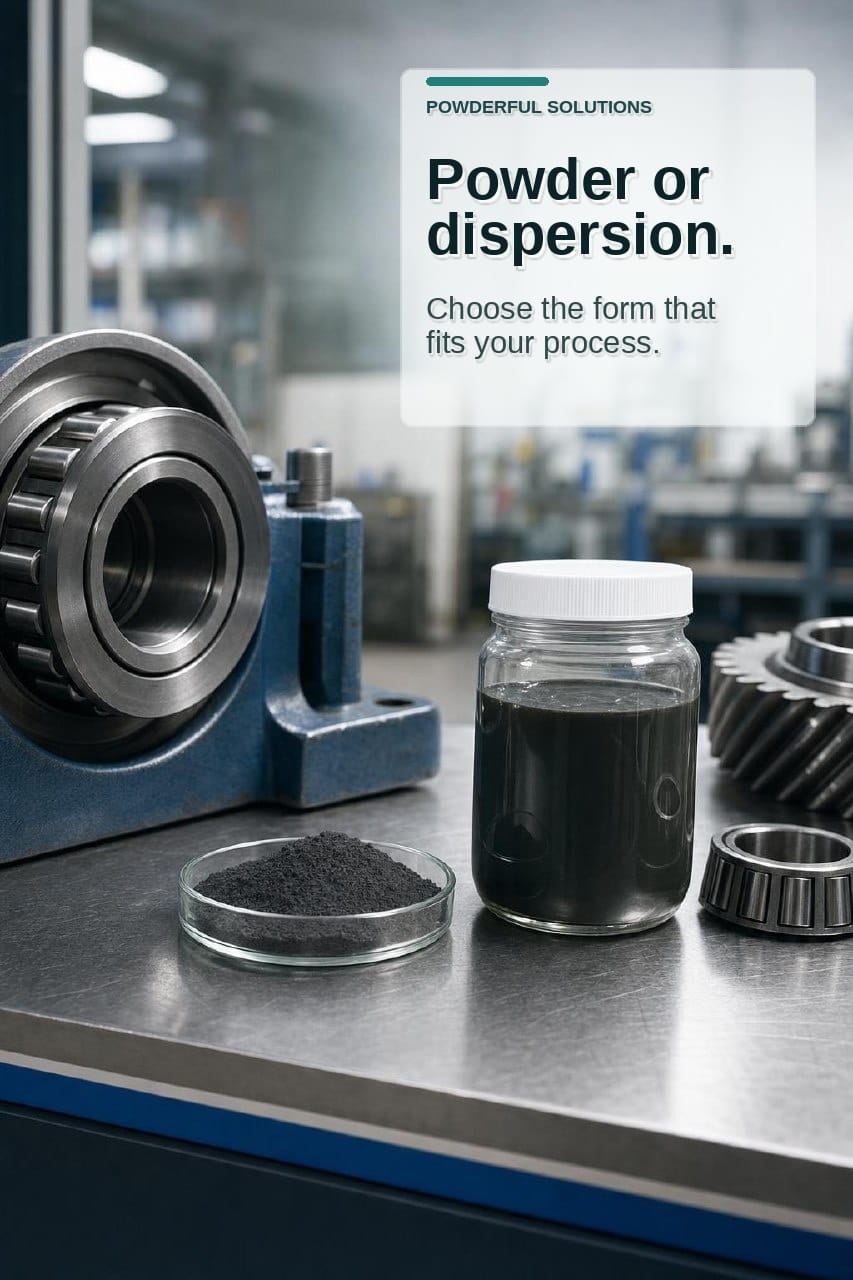
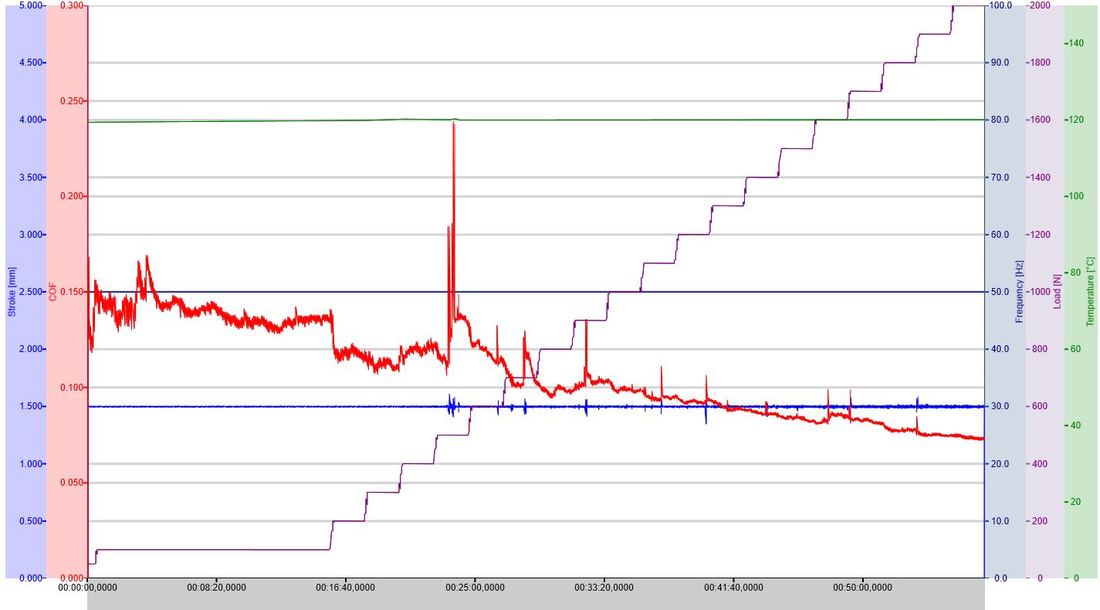
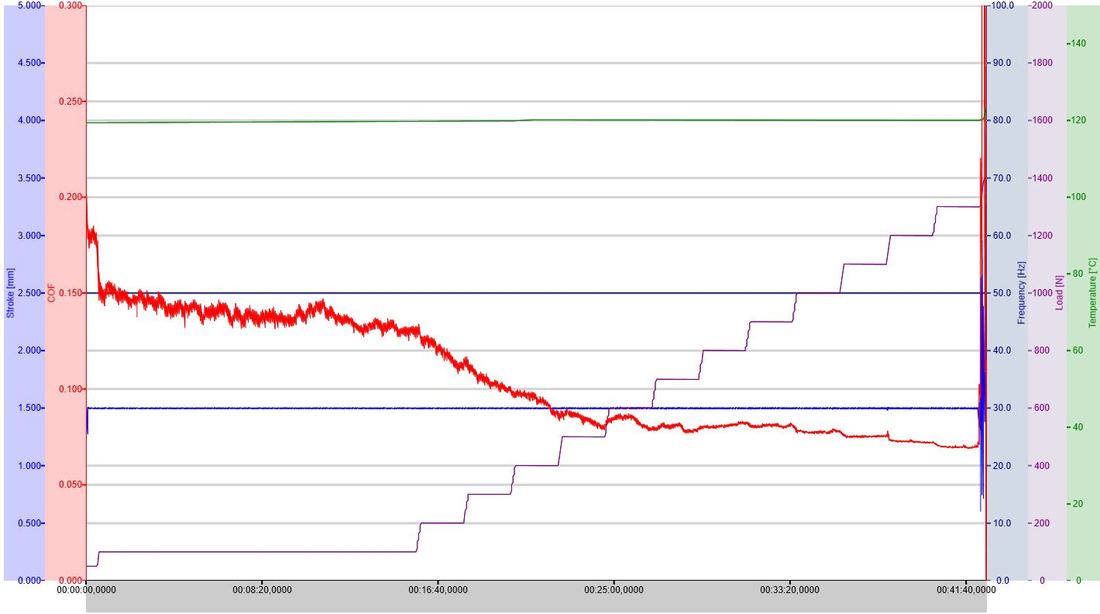
The owner-provided creative package for this topic included the following reference visuals. They are added here to show the powder-versus-dispersion format contrast and the supplied SRV traces.
Sources
Disclaimer
Performance figures are based on internal laboratory testing and field studies under specific conditions. Actual results vary depending on application, operating conditions, equipment age, base oil and additive package, ambient environment, and formulation. Figures shown are not a guarantee of savings or performance any individual user will achieve. Test before scaling.


Leave a Reply