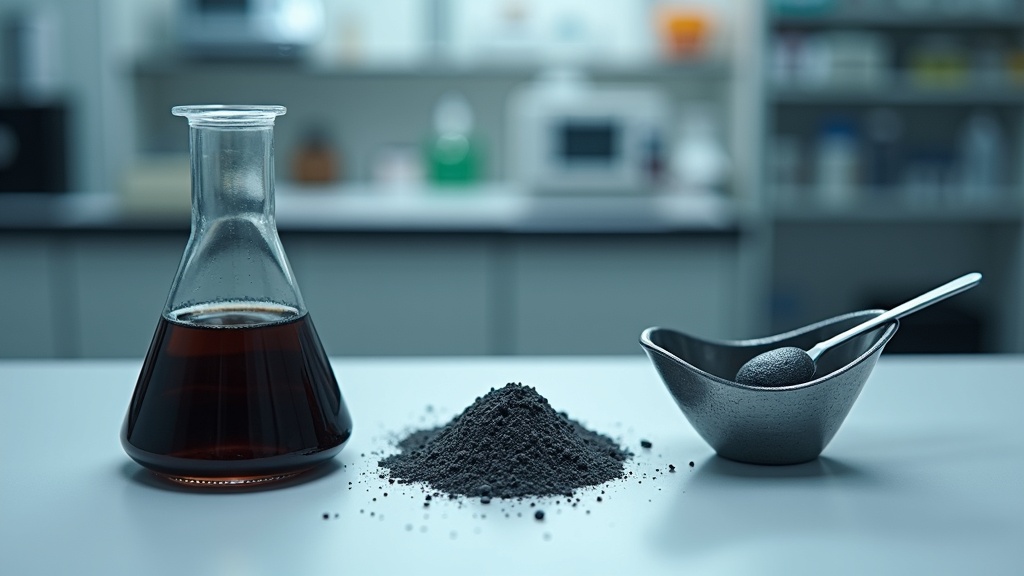
A formulator evaluating a solid lubricant additive for the first time tends to focus on chemistry: WS₂, MoS₂, hBN, or a blended platelet system. That choice matters, but it is rarely the one that decides whether the additive works in production. The earlier and often more consequential decision is form factor: do you bring the solid lubricant into the formulation as a submicron dispersion in a carrier oil, as a dry layered-platelet powder, or as a pre-formulated grease concentrate?
Each form has a defensible use case. Each carries a workflow tax that shows up only after you commit. This post lays out the practical selection logic — written for the formulator who has been burned at least once by an additive that “worked in the beaker but settled in the drum.”
Submicron Solid Lubricant Dispersion
A dispersion is solid lubricant particles already wetted, milled, and suspended in a carrier oil — typically a mineral, PAO, ester, or polyglycol base chosen for compatibility with the customer’s finished product.
When it is the right choice: – Liquid lubricant formulations — engine oils, gear oils, hydraulic fluids, metalworking fluids — where you need the solid additive uniformly distributed in a fluid system – High-precision dosing is required and weighing dry powder cleanly is operationally awkward – Settling control matters — a properly formulated submicron dispersion stabilizes the suspension chemistry; redispersing a settled drum is far easier than resuspending dry powder in oil – Dust control and lab cleanliness are operational priorities (dispersions eliminate airborne fine-particle exposure during charging)
Tradeoffs: – Carrier oil compatibility constrains where the dispersion fits — a PAO-carrier dispersion in a polyglycol gear oil is a compatibility experiment, not a drop-in – Cost per kilogram of active solid is higher than dry powder because you are also paying for the carrier and the milling process – Storage and shelf-life specifications must be respected — dispersions are not indefinitely stable
Dry Layered-Platelet Powder
Dry WS₂, MoS₂, or hBN powder shipped in sealed bags or drums, typically with a defined particle-size distribution and purity specification.
When it is the right choice: – Grease manufacturing at scale where the customer prefers to control the dispersion process inside their own kettle, often during the saponification or thickening stage – Dry-film coating applications — bonded coatings, burnishing operations, dry powder lubrication where no carrier is needed – Cost-sensitive bulk consumption where the formulator has the equipment and process knowledge to homogenize dry powder into the finished product without agglomeration – Custom carrier systems where the formulator wants to define the carrier rather than accept the supplier’s choice
Tradeoffs: – Particle agglomeration in the kettle is a real risk — high-shear mixing or pre-wetting steps are usually required – Dust handling and operator exposure controls are needed during charging – Dosing accuracy at low treat rates (under 2%) is harder than with a dispersion, especially in small-batch lab work – Storage drums opened repeatedly absorb moisture; lot-to-lot variability is harder to manage than with a dispersion
Pre-Formulated Grease Concentrate
A grease concentrate is a finished or semi-finished grease that already contains the solid lubricant active at a defined high loading — often 5–25% by weight — designed to be diluted into a customer’s base grease at a target treat rate.
When it is the right choice: – Grease blenders without dedicated solid-lubricant handling equipment who want a turnkey way to dose layered-platelet additives – Small-batch and custom grease formulations where the cost of standing up dry-powder handling for a one-off run is prohibitive – Reformulation projects where the customer is replacing a PTFE or other fluoropolymer additive with a layered-platelet system and wants the cleanest possible substitution path – Field-blending and on-site grease customization in maintenance and reliability operations
Tradeoffs: – The base grease in the concentrate must be compatible with the customer’s finished base — a lithium-complex concentrate diluted into a calcium-sulfonate base is a thickener compatibility question, not a free pass – Per-kilogram cost is highest of the three forms, because you are buying the additive plus a fully manufactured carrier grease – Less flexibility on carrier chemistry — you accept the concentrate manufacturer’s choices
Lab and field results — actual results vary by base grease chemistry, blending equipment, and operating conditions.
A Quick Selection Heuristic
A short decision tree for first-pass selection:
- Are you formulating a fluid or a grease?
- Do you have dry-powder handling equipment and process know-how?
- Is this a one-off small batch or a high-volume production run?
- Is base oil or thickener compatibility unproven?
Where Settling Risk Comes In
Settling is the failure mode formulators worry about most after handling. A few principles:
- Dispersions that are properly stabilized maintain suspension over typical shelf life; if a drum has been static for months, gentle agitation usually restores homogeneity. Solids dropping out of a dispersion is a sign the formulation is wrong, not a normal operating condition. [src: NLGI grease formulation guidance]
- Dry powders do not settle (no liquid phase) but agglomerate during storage when humidity is uncontrolled. Re-sieving is sometimes needed before charging.
- Grease concentrates do not settle — the thickener structure holds the solid lubricant in place. Oil bleed is a separate consideration tied to the carrier grease formulation, not to the solid lubricant.
Trial Workflow
For a formulator evaluating a new solid lubricant additive line, a sensible first-pass workflow:
- Specify the finished product target (fluid or grease, base chemistry, thickener if grease, target treat rate, key performance benchmarks)
- Request samples in the form factor that matches your manufacturing process
- Run a small-batch trial — match treat rate, document mixing parameters, capture before/after performance data on the test methods that matter for your specification (D2596, D2266, D4172, FZG, Timken, depending on application)
- Validate compatibility (no separation, no thickener disruption, no color/odor surprises)
- Only then scale to a pilot batch
Skipping straight from sample drum to pilot batch is the most common source of “the additive worked in the lab but failed in production” stories. The form-factor decision is part of that workflow, not separate from it.
Asking for the Right Sample
For teams evaluating solid lubricant additives, sample requests move faster when the inquiry includes the target finished product, base chemistry, target treat rate, performance specification, and preferred form factor. That gives the supplier enough context to recommend the right starting point and a practical validation path.
—


Leave a Reply