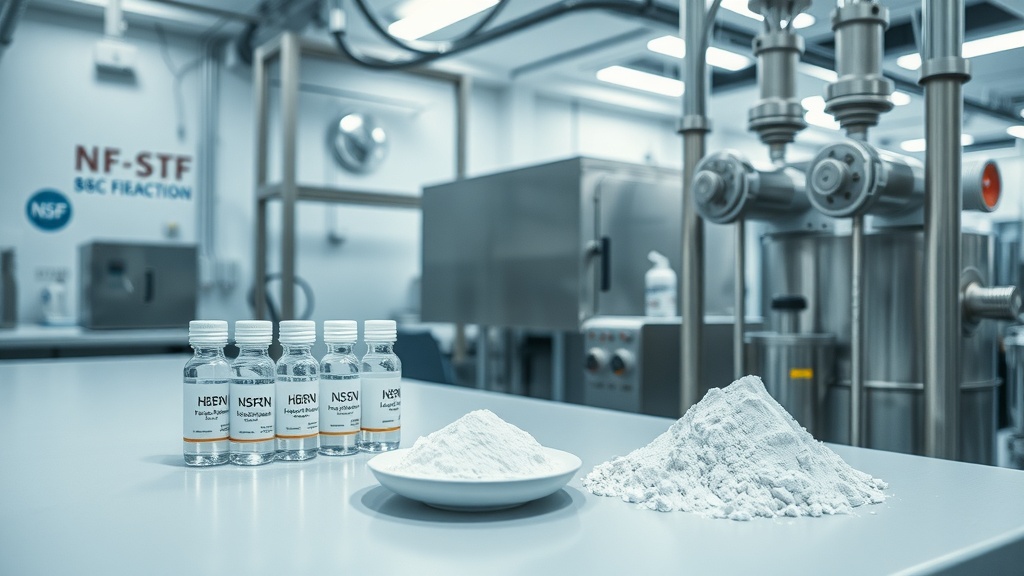
The regulatory floor for food-processing lubricants is not getting lower. As global food safety frameworks converge around NSF International’s registration scheme, formulators supplying food and beverage equipment manufacturers face an increasingly unforgiving compliance landscape. NSF International has expanded its HX-category registration program over the past two years, and FDA 21 CFR 178.3570 remains the statutory backbone governing every base stock and additive in an incidental-contact formulation. If you are an NSF HX1 certification lubricant formulator who has spent time auditing ingredient lists only to find that a single unapproved additive invalidates the entire package, this guide is for you.
What HX1 Actually Means — and Why It Is Not the Same as H1
The H1/H2/H3 hierarchy describes finished lubricant categories. H1 lubricants are registered for use where incidental food contact may occur, subject to a maximum 10 ppm carry-over limit per FDA 21 CFR 178.3570. HX1 sits one level up the supply chain: it designates individual ingredients — base stocks, thickeners, additives — that NSF has pre-screened as acceptable for use in H1 finished formulations.
This distinction matters enormously at the bench. A formulator assembling an H1 grease cannot simply declare H1 status on the finished product unless every ingredient in the formula carries its own HX1 registration or complies with 21 CFR 178.3570. The common mistake is treating H1 as a property of the finished blend without verifying the additive component stack. NSF International’s publicly searchable White Book database is the definitive verification resource; cross-checking every CAS number against it before finalizing a formulation is non-negotiable.
ISO 21469 adds a process and GMP layer on top of H1 chemistry, but HX1 registration is the chemistry gate you must clear first.
The Additive Selection Problem in Food-Grade Greases
Standard EP additive packages built around chlorinated paraffins, zinc dialkyldithiophosphates (ZDDP), or conventional sulfur-phosphorus chemistries often fail HX1 review because of toxicological concerns or the absence of 21 CFR listing. This leaves formulators choosing between weak-EP food-grade products and expensive reformulation cycles.
The Desilube product line was developed specifically to close this gap. Desilube 88 and Desilube 98F are NSF HX1 approved solid-lubricant EP additives built on S-P chemistry. At 0.5–2.5% treat rate in a lithium-complex or polyurea base grease, they deliver measurable extreme-pressure and anti-wear performance while keeping the entire formulation within incidental-contact compliance. Because they function as solid-particle dispersants rather than fluid-phase reactive chemistries, they provide load-carrying capacity without the corrosion risk associated with aggressive sulfur-phosphorus oil additives.
For thickener selection, hexagonal boron nitride (hBN) from Powderful Solutions — specifically Solidex B025 — adds a complementary layer of lubricity and thermal stability. Solidex B025 is formulated for 0.25–0.5% incorporation in food-grade greases. Unlike PTFE, which decomposes at 260°C and generates perfluorinated byproducts, hBN remains stable above 900°C. In food-processing environments where steam-in-place (SIP) cycles and high-temperature ovens are routine, that thermal margin is not theoretical — it is the difference between a lubricant that survives a maintenance cycle and one that requires reapplication every shift.
Combining Desilube 88 or 98F (0.5–2.5%) with Solidex B025 hBN (0.25–0.5%) in an appropriate NSF HX1 compliant base produces a PTFE-free, high-EP food-grade grease — a formulation architecture that addresses the most frequent pain point in food-grade grease development: inadequate EP protection within compliant chemistry.
Navigating the NSF White Book and 21 CFR 178.3570
Practical compliance requires understanding that NSF HX1 registration and 21 CFR 178.3570 listing are not always coextensive. Some substances are listed in 21 CFR but have not been submitted for NSF HX1 registration; others have HX1 registration through NSF’s independent evaluation program. The safest path for a formulator is to require explicit HX1 registration for every performance-critical additive and rely on 21 CFR listing only for commodity base fluids and thickeners with long regulatory histories.
NSF International Category HX1 covers antiwear and EP agents, corrosion inhibitors, antioxidants, friction modifiers, and viscosity modifiers. Each must be individually registered — no blanket approval exists for chemical families. This means that even if one sulfonate corrosion inhibitor carries HX1 status, a structurally similar analog from a different supplier may not. Formulators working with Desilube Inc. receive ingredient-level documentation covering each additive’s regulatory standing, which substantially reduces the compliance audit workload when submitting a finished product for H1 registration.
Performance Benchmarking Under Food-Grade Constraints
The persistent criticism from equipment OEMs is that food-grade greases sacrifice load-carrying performance relative to industrial-grade alternatives. This criticism is partially founded when formulators fall back on low-treat-rate mineral oil systems with calcium sulfonate thickener and no solid-lubricant EP package.
With a Desilube 88 or 98F / Solidex B025 combination, ASTM D2596 four-ball weld point performance can match or exceed many non-food-grade lithium EP greases. The solid-lubricant mechanism — physical interposition of platelet particles between metal surfaces — does not depend on reactive chemistry, which is precisely why it clears toxicological review. That is a convergence of regulatory compliance and tribological performance that older PTFE-based approaches cannot offer.
Thermal testing in polyurea and lithium-complex bases has confirmed hBN stability at temperatures well above the continuous service limits of the base thickener itself, meaning the solid lubricant component is not the limiting factor in high-temperature food-processing applications.
Formulation Strategy: Getting to Market Faster
The compliance timeline for a new food-grade grease — from ingredient vetting through NSF H1 finished-product registration — typically runs six to eighteen months. Formulators who start with a verified HX1 ingredient stack cut that timeline substantially because the heaviest document-gathering burden is already resolved at the component level.
The recommended workflow: specify your base fluid first from NSF-listed White Mineral Oil or PAO options, confirm HX1 status for thickener and additive package individually, and validate the combination with ASTM D2596, ASTM D2509, and ASTM D2266 tribological testing before submitting the finished product file to NSF. Desilube 88 and 98F come with full regulatory support documentation. Solidex B025 carries an HX1-compliant ingredient profile for food-grade grease applications.
Formulators with eighteen-plus years of institutional experience from major lubricant houses — Shell, FUCHS, Klüber, Total — understand that no shortcut in the compliance stack survives a customer audit. Building with pre-registered ingredients from the start is not a conservative approach; it is the efficient one.
For formulation support, ingredient documentation, and sample requests, contact Desilube Inc. directly, or explore the complete solid-lubricant additive portfolio at Powderful Solutions including the NSF HX1 food-grade lubricant additive range.


Leave a Reply