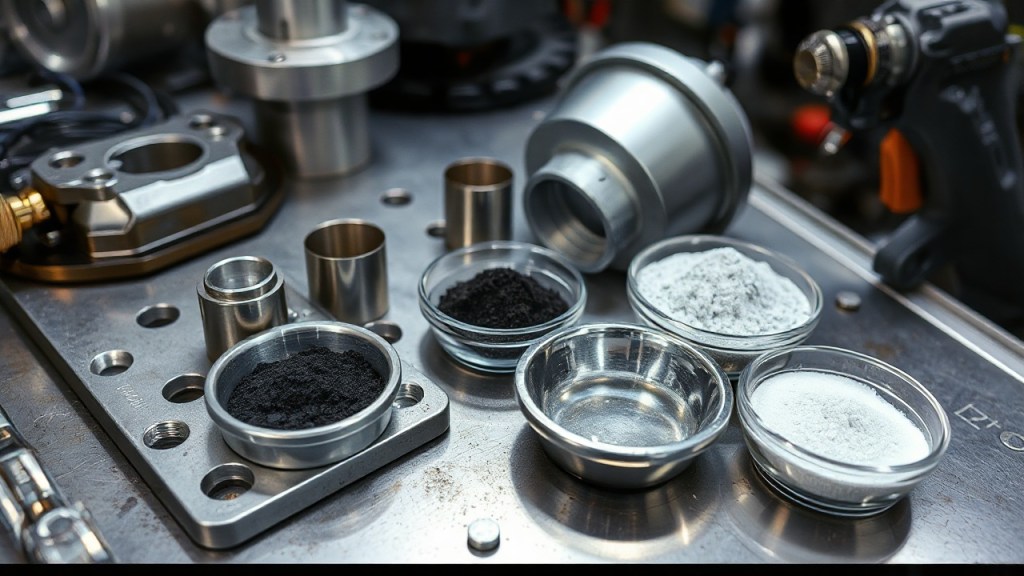
Dry film coatings based on MoS2, WS2, and hBN solid lubricants represent one of the most technically demanding—and most underformulated—areas of industrial lubrication. When fluid lubricants fail due to temperature extremes, vacuum conditions, or contamination risk, dry film coatings deliver reliable boundary lubrication with zero volatility, zero outgassing, and predictable performance over thousands of operating cycles. This guide covers the chemistry, application methods, and formulation parameters for each material, based on published tribology data and field-validated results.
What Is a Dry Film Coating?
A dry film lubricant coating is a solid lubricant layer—typically 2–25 micrometers thick—applied to a substrate surface and cured or bonded to provide durable low-friction performance. Dry film coatings are specified when:
- Operating temperatures exceed fluid lubricant flash points or stability limits
- Vacuum or cleanroom environments prohibit fluid lubricants
- Re-lubrication is impractical (aerospace fasteners, sealed bearings, small mechanisms)
- Contamination of adjacent materials (food, semiconductors, optics) must be eliminated
The three dominant solid lubricant materials for dry film applications are MoS2, WS2, and hBN—each with distinct performance profiles and optimal application domains.
MoS2 Dry Film Coatings: High Load, High Vacuum Performance
Molybdenum disulfide (MoS2) is the most established dry film lubricant. Its layered hexagonal crystal structure provides low shear strength between basal planes, generating coefficients of friction as low as 0.05 in controlled environments. MoS2 dry film performance characteristics:
- CoF in vacuum: 0.01–0.05 (among the lowest of any solid lubricant)
- CoF in air: 0.05–0.15 (oxidation increases friction at temperatures above 350°C)
- Load capacity: excellent under high Hertzian contact stress
- Standard coating thickness: 5–20 µm via burnishing, bonded film, or sputtering
MoS2 dry film coatings are specified by aerospace OEMs (Boeing, Airbus, NASA) for bolted joint anti-galling, actuator sliding surfaces, and satellite mechanism bearings. MoS2 is sensitive to humidity; in ambient-air applications above 60% RH, performance degrades. Bonded film formulations with binders such as epoxy or polyimide improve humidity resistance significantly.
Powderful Solutions’ submicron MoS2 dry film dispersions are engineered at controlled particle sizes (D50 0.3–0.8 µm) for uniform coating density and consistent tribological response across production batches.
WS2 Dry Film Coatings: Superior Oxidation Resistance and Thermal Stability
Tungsten disulfide (WS2) has emerged as the premium MoS2 WS2 hBN dry film coating material for applications where oxidation resistance and thermal stability are primary constraints. WS2 offers measurable advantages over MoS2:
- Thermal stability in air: up to 450°C (vs. ~350°C for MoS2)
- Oxidation resistance: WS2 forms a protective WO3 layer that partially self-limits further oxidation
- CoF: 0.03–0.08 in air—lower than MoS2 under humid conditions
- Chemical inertness: resistant to dilute acids and oxidizing environments where MoS2 degrades
WS2 dry film coatings are the preferred specification for exhaust-side turbocharger components, high-temperature actuators, and aerospace applications where thermal cycling is severe. WS2’s lower affinity for oxygen makes it the technically correct choice when MoS2’s humidity sensitivity is a liability.
For solid lubricant grease additive applications, Torvix W720 submicron WS2 grease additive delivers 800 kgf weld point per ASTM D2596 at 2.5%—the benchmark for severe-duty grease formulation. Note: Torvix W720 is for grease only; EPXtra W110 is for engine oil.
hBN Dry Film Coatings: High Temperature, Electrical Isolation, Food-Safe
Hexagonal boron nitride (hBN) occupies a unique position in the MoS2 WS2 hBN dry film coating landscape. Where MoS2 and WS2 are electrically conductive and dark-colored, hBN is an electrical insulator and optically white. This combination is irreplaceable in specific application domains:
- Electric motor bearings: hBN dry film coatings prevent stray current damage (electrical discharge machining wear) while providing lubrication—a unique dual function
- High-temperature forming dies: hBN is thermally stable above 900°C in inert atmospheres (PTFE decomposes at 260°C)—appropriate for hot forging, extrusion, and glass forming
- Food-grade equipment: hBN is chemically inert, non-toxic, and compatible with NSF HX1 formulation when used with Desilube 88 or 98F NSF HX1-certified additives
- Semiconductor and optics: hBN’s white color and non-contaminating chemistry are essential where MoS2 or WS2 particle contamination would be catastrophic
Solidex B025 hBN from Powderful Solutions provides thermal conductivity of 0.12–0.24 W/mK at 1% in grease systems—useful in bearing greases where heat dissipation augments lubrication performance. This property is unique among solid lubricant additives; neither MoS2 nor WS2 offers comparable thermal conductivity contribution.
Formulation Guide: Dry Film Coating Systems
Dry film coatings are applied via three primary methods, each with distinct formulation requirements:
1. Burnished Dry Film (unbonded): Solid lubricant powder is mechanically burnished onto the substrate under pressure. No binder. Simple, low-cost. Suitable for MoS2 on steel; limited thickness and durability. D50 particle size should be ≤1 µm for surface coverage efficiency.
2. Bonded Dry Film (fluid-applied): Solid lubricant is suspended in a binder carrier (epoxy resin, polyimide, PTFE-free thermosetting resin) and applied by spraying, dipping, or brushing. Cured at 150–300°C. This is the dominant industrial method. Key formulation parameters:
- Solid lubricant loading: 15–40% by weight in the cured film
- Particle size: D50 0.3–1.0 µm for optimal packing density
- Binder selection: polyimide for temperatures above 250°C; epoxy for cost-optimized ambient-temperature applications
- Film thickness: 5–15 µm post-cure
3. PVD/CVD Sputter Coating: Physical vapor deposition of MoS2 or WS2 targets produces ultra-thin (0.5–5 µm), dense, highly adhesive coatings. Used in precision aerospace bearings, satellite mechanisms, and medical devices. Requires vacuum deposition equipment but delivers CoF values as low as 0.01 in vacuum service.
For application-specific formulation support, contact Powderful Solutions’ technical team for particle size specifications and binder compatibility data.
Application Selection Matrix
Selecting the correct material follows tribological requirements:
- High vacuum, space, satellite: MoS2 or WS2 PVD; MoS2 preferred in vacuum (lowest CoF)
- High temperature (>350°C), air: WS2 bonded film
- Electrical isolation required: hBN bonded film
- Food-safe, white color: Solidex B025 hBN + Desilube 88/98F binder system
- General industrial, cost-optimized: MoS2 bonded film with epoxy binder
Reference: ASTM D2266 four-ball wear, ASTM D2783 load-carrying, and Tribology Transactions (Taylor & Francis) dry film coating tribology studies provide validated performance benchmarks for each system.
Conclusion: Specify the Right Dry Film Lubricant for Your Application
MoS2, WS2, and hBN dry film coatings each solve specific engineering problems that fluid lubricants cannot. The selection is not arbitrary—thermal envelope, electrical requirements, environmental conditions, and regulatory compliance (NSF HX1, food safety, contamination control) all drive the correct specification.
Powderful Solutions supplies Solidex B025 hBN, submicron MoS2 dispersions, and Torvix W720/EPXtra W110 WS2 additives for industrial dry film and grease formulation. Request technical data sheets and dry film coating application samples to validate your formulation.


Leave a Reply