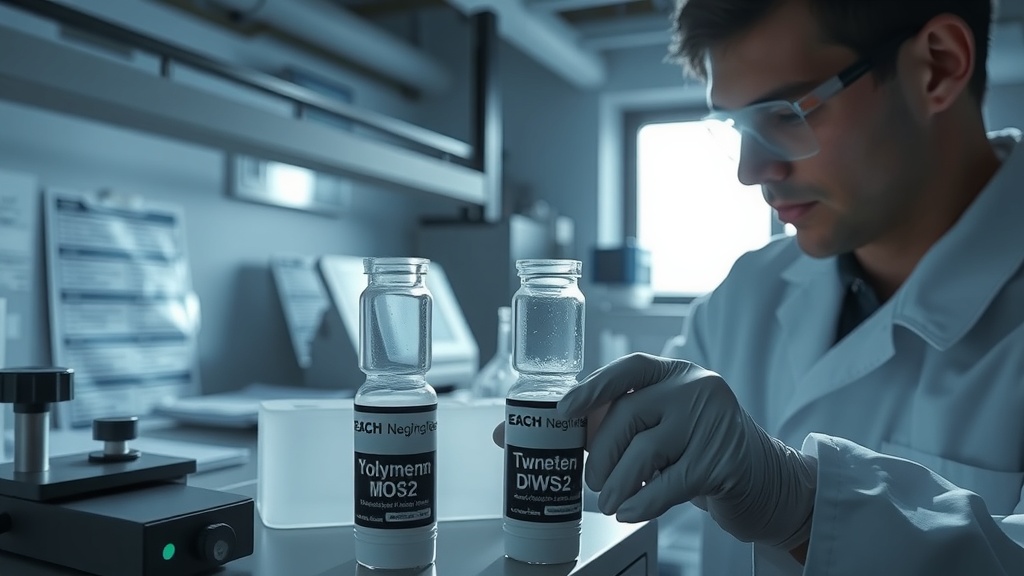
In March 2026, ECHA’s Committee for Risk Assessment (RAC) issued its final opinion recommending an EU-wide class-based PFAS restriction. Lubricants account for approximately 800 metric tons per year of PFAS emissions. SEAC is now evaluating the restriction with a possible 12-year derogation for critical applications, but the direction of travel is clear: PTFE in lubricants is on borrowed time. Formulators who haven’t started the transition to PTFE-free alternatives are already behind the curve. Submicron MoS2 and WS2 dispersions are the technically validated path forward.
Why Formulators Are Moving Away From PTFE in 2026
PTFE (polytetrafluoroethylene) has been a workhorse solid lubricant additive for decades. Its low coefficient of friction (CoF ~0.04–0.08), chemical inertness, and easy dispersibility made it attractive in both grease and engine oil formulations. The problem is structural: PTFE is a fluoropolymer. Under the EU PFAS restriction framework — and increasingly under US EPA guidance — it falls within the regulated chemical class.
Beyond regulatory exposure, PTFE has real technical limitations formulators often overlook. It decomposes at 260°C, releasing perfluorinated decomposition products. It provides minimal extreme-pressure (EP) protection because it cannot form a reactive tribofilm under load. And in engine oil applications, PTFE particles can migrate to oil filters, building up deposits that reduce filtration efficiency over extended drain intervals.
None of these limitations apply to MoS2 or WS2.
Understanding MoS2 and WS2 as PTFE Replacements
Molybdenum disulfide (MoS2) and tungsten disulfide (WS2) are transition metal dichalcogenides with a hexagonal layered crystal structure. The weak van der Waals forces between sulfur planes allow these layers to slide under shear, generating low friction at the contact interface — the same fundamental mechanism as PTFE, but without the fluorine chemistry.
The performance difference against PTFE becomes apparent under pressure. At 2.5% treat rate in a lithium complex grease, Torvix W720 submicron WS2 dispersion achieves an 800 kgf weld point per ASTM D2596. Standard MoS2 at 10% treat rate achieves comparable weld points. PTFE at any treat rate does not approach this EP performance — the polymer doesn’t participate in the boundary lubrication chemistry that protects asperity contacts under extreme load.
Key performance comparison:
- WS2 vs MoS2: WS2 delivers lower CoF, higher thermal stability (stable to 450°C in air vs. MoS2’s 350°C), and better oxidation resistance. Use WS2 where extended drain intervals or high-temperature operation are required.
- MoS2 advantage: Lower cost per kilogram, proven 60+ year track record in mining and heavy industry, excellent film-forming at higher treat rates. Ideal for open gear lubricants, wire rope, and high-load slow-speed applications.
- Both vs PTFE: Superior EP protection, no fluorine content, thermally stable well beyond PTFE’s 260°C decomposition point.
Grease Formulation: How to Use Submicron MoS2 and WS2 Dispersions
The critical formulation variable is particle size. MoS2 and WS2 powders in the 1–5 µm range can cause settling in liquid systems and filter plugging in recirculating grease systems. Sub-micron MoS2/WS2 dispersions — pre-dispersed in base oil with dispersant chemistry — solve the stability problem and enable consistent treat rates at lower loading.
For grease applications, the recommended approach:
- Base grease selection: Lithium complex, polyurea, or calcium sulfonate complex thickeners are all compatible. Avoid greases with oxidizing EP additive packages that could react with MoS2 sulfur chemistry at elevated temperature.
- Treat rate — WS2: Torvix W720 at 2.5% delivers 800 kgf weld point ASTM D2596. This replaces 10% standard MoS2 powder at equivalent EP performance — a 4× efficiency advantage.
- Treat rate — MoS2: Submicron MoS2 dispersions typically perform at 3–5% in grease for heavy-load applications. Blending with WS2 at lower combined treat rates is a cost-optimized approach.
- Incorporation: Add solid lubricant dispersions at the end of the manufacturing process, below 80°C, with slow mixing to avoid shear-induced agglomeration. Do not expose to high-shear homogenization after dispersion addition.
- Stability testing: Run 30-day storage stability at 40°C, 60°C, and room temperature before final formulation lock.
For food-grade grease applications requiring PFAS compliance, combine submicron MoS2 or WS2 with Desilube 88 or 98F NSF HX1 solid lubricant additives at 0.5–2.5% treat rate. This combination delivers EP protection, low friction, and full NSF HX1 compliance without any fluorinated chemistry.
Engine Oil Formulation: WS2 Dispersions for PTFE-Free EP Protection
Engine oil formulation presents different stability challenges than grease. The dispersion must remain stable through the shear of the oil pump, maintain colloidal stability over extended drain intervals, and not interfere with existing additive chemistry — particularly ZDDP, which provides its own tribofilm chemistry.
WS2 is the preferred solid lubricant for engine oil applications. EPXtra W110 is specifically formulated for crankcase applications: submicron WS2 particles pre-dispersed in a Group III compatible carrier with dispersant and antioxidant chemistry. The treat rate is 0.5–1.5% in finished oil.
Key engine oil formulation considerations:
- Compatibility: WS2 dispersions are compatible with ZDDP, MoDTC, OA-based friction modifiers, and standard VI improvers. Confirm compatibility with amine-based corrosion inhibitors in your specific package before scale-up.
- Filter media: Submicron WS2 particles (below 0.3 µm) pass standard full-flow filters (typically 10–20 µm nominal). Bypass filters at 1–3 µm may capture some particles — monitor oil analysis particle counts if using fine bypass filtration.
- Oil analysis: WS2-treated oils show elevated tungsten and sulfur on spectrographic analysis. Establish baseline reference ranges for your specific treat rate to avoid false-positive wear alerts.
- PTFE replacement: Unlike PTFE, WS2 does not accumulate on filter media at particle sizes below 0.5 µm. WS2 tribofilms are self-regenerating: as particles are consumed at the contact interface, fresh particles from the bulk oil replace them.
Shell, FUCHS, Klüber, and Total Energies have incorporated submicron WS2 and MoS2 dispersions in formulated products for 18+ years — the technology is proven at scale, not experimental.
Switching to PTFE-Free: Checklist for Formulators
A structured approach to PTFE replacement reduces development time and avoids late-stage reformulation surprises:
Regulatory audit
- Identify all formulations containing PTFE or other fluoropolymers
- Map to end-use applications and customer geographies (EU exposure is highest-risk)
- Flag applications with food-contact, marine overboard, or agricultural use — tightest regulatory timelines
Technical evaluation
- For each PTFE-containing formulation, define: target CoF, EP requirement (weld point / load-carrying), operating temperature range, compatibility constraints
- Select WS2 for high-temperature, extended-drain, or oxidizing environments; MoS2 where cost is primary driver
- Run four-ball wear (ASTM D4172) and EP (ASTM D2596/D2783) testing with candidate treat rates
Stability validation
- 30-day storage stability (temperature cycling)
- Shear stability (ASTM D217 worked penetration after 100,000 strokes for grease)
- Oil separation (ASTM D1742 for grease)
Documentation
- Update SDS: remove fluoropolymer references, add MoS2/WS2 composition data
- If food-grade: initiate NSF HX1 registration update with Desilube 88/98F and submicron WS2/MoS2 dispersion data
- Notify customers of formulation change per contractual requirements
The PFAS restriction timeline is not speculative — RAC’s final opinion is on record. Formulators who complete the transition to submicron MoS2 and WS2 dispersions before the restriction takes effect will have a REACH-compliant, technically superior product line. Those who wait will face reformulation under regulatory deadline pressure.
Request formulation data sheets and sample quantities for Torvix W720 WS2 grease additive, EPXtra W110 engine oil WS2 additive, and submicron MoS2 dispersions at powderfulsolutions.com. For food-grade and NSF HX1 formulation support, contact the team at desilubeinc.com.
 Powderful Solutions Blog
Leave a comment