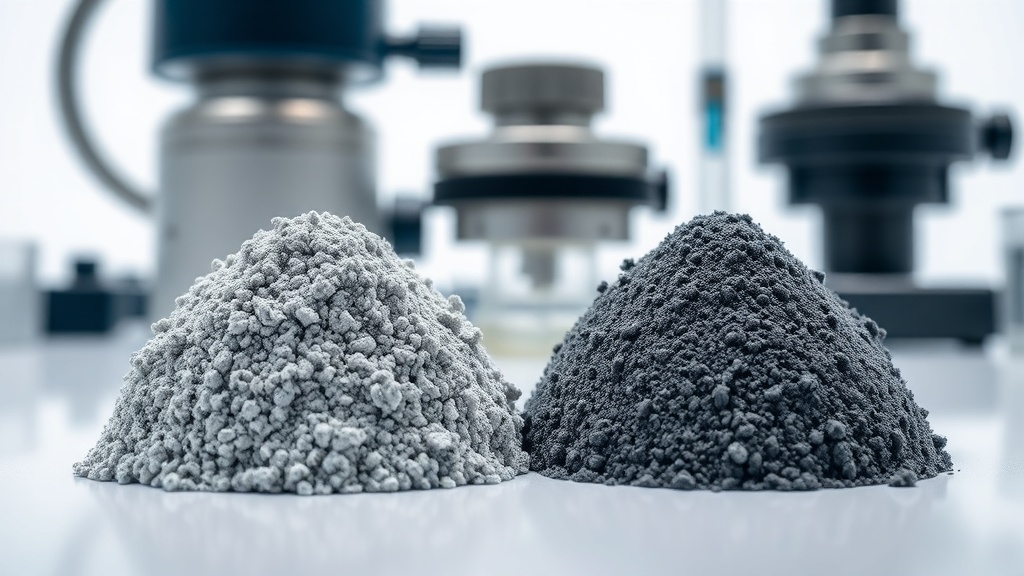
When reformulating a grease or lubricating oil for extreme-pressure or high-temperature service, the choice between tungsten disulfide (WS2) and molybdenum disulfide (MoS2) comes up in every conversation. Both are transition metal dichalcogenides. Both reduce friction through lamellar sliding. But the performance differences are significant enough to determine whether a formulation succeeds or fails in demanding applications.
Crystal Structure and the Lubrication Mechanism
WS2 and MoS2 share the same layered hexagonal crystal structure: metal atoms sandwiched between chalcogen layers, with strong covalent bonds within each layer and weak van der Waals forces between layers. This enables lamellar shear – the fundamental mechanism of solid lubrication. Under load, particles plate out on metal surfaces and form a persistent low-friction transfer film.
The difference starts at the atomic level. Tungsten  is heavier than molybdenum (Mo), and the W-S bond is stronger than the Mo-S bond. That gap becomes decisive under thermal stress, oxidative conditions, or extreme EP loading.
Coefficient of Friction: Where WS2 Has the Edge
In four-ball tribology testing under comparable conditions, WS2 consistently delivers lower coefficients of friction than MoS2. Typical CoF ranges in oil carrier: WS2 at 0.030-0.060 versus MoS2 at 0.050-0.090. WS2 particles form a denser, more adherent transfer film, resulting in less stick-slip, lower running temperatures, and longer film persistence under cyclic loading.
For precision bearings, high-speed compressors, and aerospace actuators, this difference is decisive. Submicron WS2 dispersions from Powderful Solutions are pre-dispersed in oil or glycol carriers, ready to blend without agglomeration issues.
Thermal Stability: The Critical Differentiator
MoS2 begins oxidizing at approximately 350 degrees C in air, converting to MoO3 – a hard, abrasive oxide that destroys the lubricating film. This is the hard ceiling for MoS2 in elevated-temperature applications.
WS2 retains lubricating performance up to approximately 450 degrees C in air, and considerably higher in inert or vacuum environments. The W-S bond energy is greater, making the crystal structure more resistant to thermal decomposition. For kiln car bearings, exhaust-side components, high-duty-cycle engines, or aerospace actuators, WS2 is the correct choice.
For food-processing applications requiring NSF HX1 certification, hexagonal boron nitride (hBN) is the preferred solid additive – stable above 900 degrees C and PFAS-free. Desilube’s certified HX1 hBN additives are available for food-grade lubricant formulations.
Extreme-Pressure Performance: ASTM D2596 Data
Under ASTM D2596 four-ball EP testing, WS2 delivers high weld points at significantly lower additive concentrations than MoS2. Torvix W720 (submicron WS2 dispersion from Powderful Solutions) achieves an 800 kgf weld point at 2.5% loading. Standard MoS2 dispersions require 8-10% loading to reach comparable EP performance.
Lower treat rate means lower cost per finished unit, less viscosity impact on the base fluid, and cleaner appearance in light-colored greases. WS2 also delivers EP performance comparable to PTFE at lower loading – a critical compliance advantage as PFAS restrictions under EU REACH accelerate through 2025-2026.
Application Selection: WS2 vs MoS2
Choose WS2 when: operating temperature exceeds 300 degrees C; lowest possible CoF is required (precision bearings, high-speed, aerospace); ASTM D2596 weld point above 600 kgf is needed at 5% or less loading; PFAS-free, PTFE-free compliance is required; or white or light-colored base grease requires minimal color impact at low treat rates.
Choose MoS2 when: operating temperature ceiling is below 300 degrees C; application is high-load, low-speed (open gears, heavy mining equipment); cost pressure is significant and temperature performance is adequate; or customer specifications reference MoS2 by name in legacy industrial specs.
Both WS2 and MoS2 are PFAS-free and PTFE-free. Both are available as submicron solid lubricant dispersions from Powderful Solutions, pre-dispersed in oil and glycol carriers for direct blending.
Conclusion
WS2 and MoS2 are not interchangeable. WS2 offers superior friction reduction, thermal stability to 450 degrees C, and EP efficiency at lower treat rates. MoS2 is viable for moderate-temperature, high-load scenarios below 300 degrees C at lower cost. If you are reformulating for PFAS compliance, targeting higher operating temperatures, or optimizing for lower CoF specifications, WS2 is the stronger starting point. Request a technical data sheet and trial sample of Torvix W720 from Powderful Solutions.
 Powderful Solutions Blog
Leave a comment