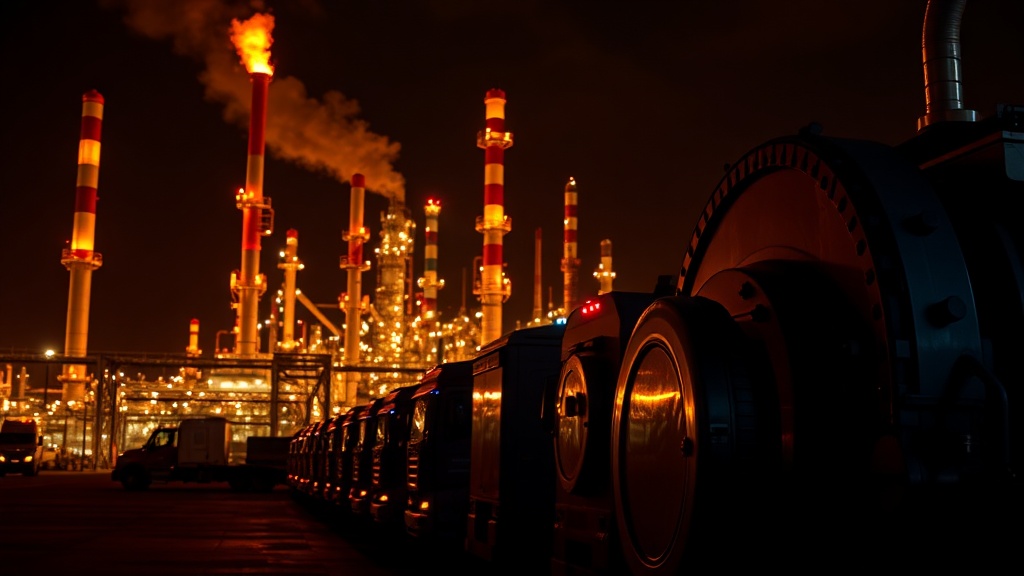
Brent crude closed above $100 per barrel on March 13, 2026, for the first time since 2022 — and it may not stop there. JPMorgan Chase has warned that a full escalation of the Iran-U.S. standoff around the Strait of Hormuz could push prices to $120. For fleet operators, mining companies, and industrial manufacturers running thousands of diesel-powered assets, this is not a forecast to dismiss. It is a cost emergency that demands an immediate operational response.
The conventional response is to wait, hedge fuel contracts, or pass costs downstream. The smarter response is to address the one variable you actually control: mechanical friction losses, which account for 15–25% of total engine fuel consumption in heavy diesel equipment.
The Hormuz Premium and What It Means for Operating Costs
The Strait of Hormuz handles approximately 21% of global oil supply daily. Any sustained disruption — whether through Iranian naval activity, mining operations, or direct conflict — adds a risk premium that analysts estimate at $15–25 per barrel. For a mining operation running 50 Cummins KTA engines at 300 hours per month each, a $20/barrel increase translates directly into hundreds of thousands of additional fuel dollars annually. This is the economic context in which lubricant additive decisions are made.
How Submicron Solid Additives Cut Fuel Consumption
Friction losses in diesel engines fall into three categories: hydrodynamic (viscous drag in bearings and crankshafts), mixed-film (cam followers, valve trains), and boundary (piston rings at TDC and BDC). Conventional lubricants address hydrodynamic friction well. They address boundary friction poorly — which is exactly where submicron WS2 and MoS2 dispersions operate.
WS2 and MoS2 particles in the 0.3–0.9 micron range penetrate the boundary layer, form triboactive transfer films on metal surfaces, and reduce peak friction at the highest-stress points in the combustion cycle. The result is measurable fuel savings — not claimed, but documented:
- Cummins KTA fleet case study (mining): 5.85% reduction in fuel consumption after switching to Lubricore™ submicron MoS2 engine oil additive. Same engines also showed +28.8% increase in operating hours between maintenance intervals and 2x oil drain extension.
- ASTM D5707 (friction measurement): WS2 at 0.5% concentration achieves CoF of 0.030–0.045 vs. baseline 0.12 in PAO 4 at 100°C.
- FZG gear test: WS2-loaded gear oils pass load stage 12+ versus stage 9 for unformulated reference.
At $100+ crude, a 5% fuel reduction on a 500-unit diesel fleet is not a marginal gain. It is a seven-figure annual cost reduction.
Which Products Apply — And at What Dosage
Powderful Solutions offers two product lines directly relevant to fleet fuel economy:
- Lubricore™ L-Series: Submicron MoS2 and WS2 concentrates in Group I/II base oil, designed for treat-in to existing diesel engine oils. Typical dosage 0.5–1.5% v/v. Compatible with ACEA E6, E9, API CK-4 formulations.
- EPXtra™ Booster Series: High-load EP boosters for gear oils and hydraulic fluids in mining and construction equipment. Reduces wear index in ASTM D4172 (four-ball) by 35–45% vs. reference.
Both are PFAS-free, REACH-compliant, and available with full third-party test data.
The Procurement Case: ROI at $100 Oil
Consider the arithmetic for a mid-size mining operator:
- Fleet: 80 heavy diesel units (excavators, trucks, generators)
- Monthly fuel consumption: 2.4 million liters at $1.05/L = $2.52M/month
- 5% fuel reduction from WS2/MoS2 additivation: $126,000/month saved
- Annual additive cost at 1% treat rate: approximately $18,000–22,000
- Net annual ROI: $1.3M+ on a $20K investment
When oil trades at $80, this is a strong case. When Hormuz tensions keep Brent above $100, it becomes a no-brainer procurement decision that pays back in weeks.
Marine and Offshore: The EAL Compliance Layer
The March 4 explosion of the Russian-flagged gas carrier Arctic Metagaz in the Mediterranean is a stark reminder of the environmental liability exposure in marine operations. IMO MARPOL Annex V and regional regulations (including EU Directive 2013/53/EU and US VGP) mandate the use of Environmentally Acceptable Lubricants (EAL) in vessel systems with potential for oil-to-water contact.
Powderful Solutions’ Lubricore™ B250/B260 series are Group V ester-based biodegradable concentrates certified to OECD 301B/D, compatible with EAL-grade base fluids. They carry solid lubricant enhancement while meeting environmental compliance requirements — critical for operators in the North Sea, Baltic, and US coastal waters.
Conclusion: Volatile Energy Markets Reward Friction Efficiency
$100+ Brent is not an anomaly. It is the new operating environment for at least the next 6–12 months while Hormuz risk remains elevated. Fleet and maintenance engineers who address boundary friction losses with properly formulated submicron additives will outperform competitors who simply absorb the fuel cost increase.
The data exists. The products are available. The ROI is calculable today.
Contact Powderful Solutions for a fleet-specific fuel savings analysis and sample kit. We will run the numbers for your equipment and give you a specific, defensible ROI projection — not a sales pitch.
 Powderful Solutions Blog
Leave a comment